Causal Bounds for Observational Data
Uriah Finkel
Causal Question
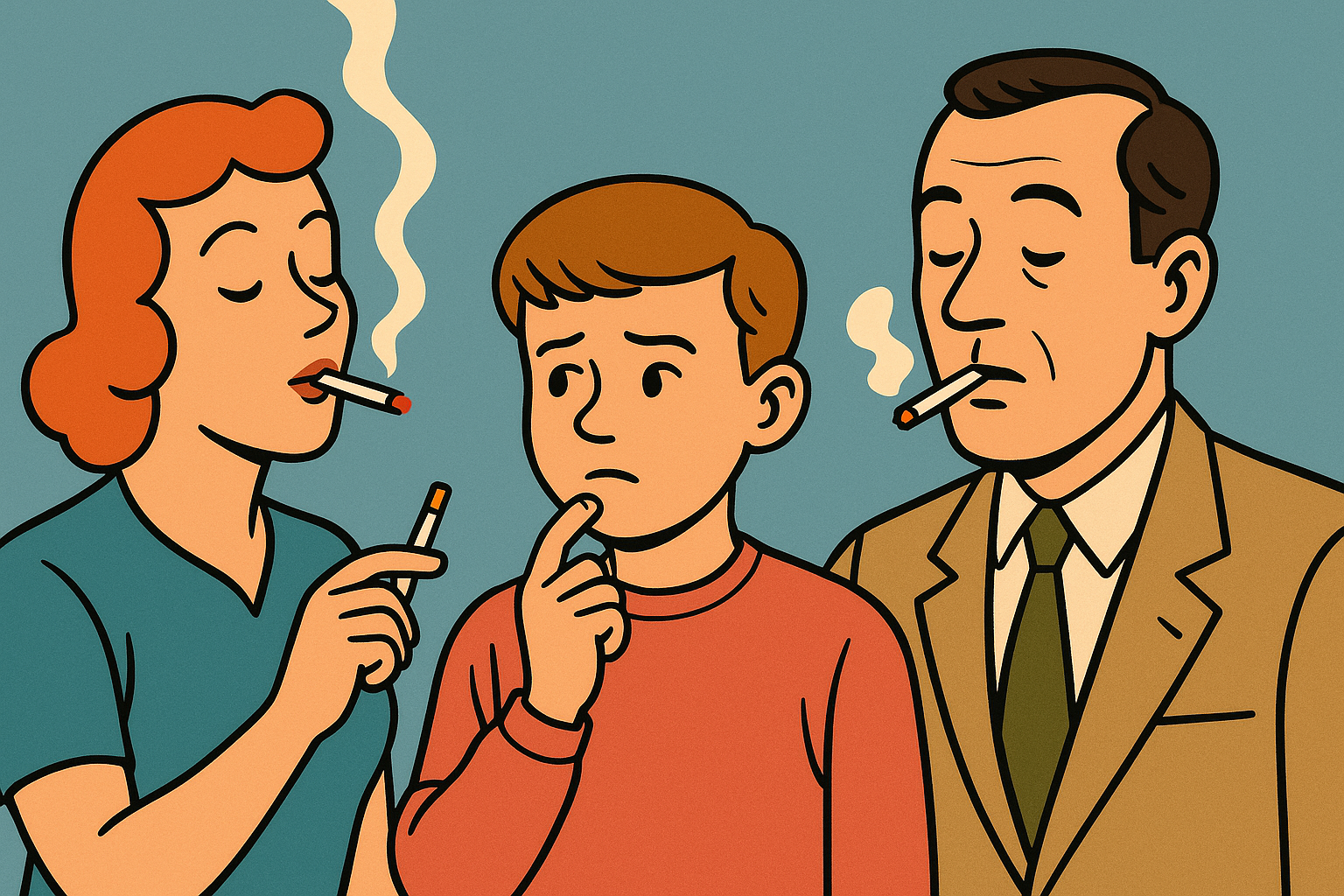
What are the bounds on the Individual Treatment Effect (ITE) of smoking 🚬 vs. not smoking 🚭 on COPD 🫁, given only one observed background variable — whether the parents smoke?
Under the Monotonicity Assumption, we assume that having smoking parents 😤 can only increase a child’s risk of developing COPD 🫁 through passive exposure.
😇 God-Given Counterfactual Data
- By God-Given knowledge we have access to the true counterfactual outcomes for each individual for smoking 🚬 and for not smoking 🚭
😇 God-Given Counterfactual Data
By God-Given knowledge we have access to the true counterfactual outcomes for each individual for smoking 🚬 and for not smoking 🚭
This gives us 4 Compliers: people who get COPD only if they smoke, and avoid it otherwise. It also goes by the name PNS: Probability of Necessity and Sufficiensy:
\(\text{PNS} = \frac{4}{16} = 0.25\)
😈 Observed Data
By God-Given knowledge we have access to the true counterfactual outcomes for each individual for smoking 🚬 and for not smoking 🚭
This gives us 4 Compliers: people who get COPD only if they smoke, and avoid it otherwise. It also goes by the name PNS: Probability of Necessity and Sufficiensy:
\(\text{PNS} = \frac{4}{16} = 0.25\)
- In real life we can analyse only the observed outcomes, so we can never know the true Individual Treatment Effect. But fortunately, we can use Causal Bounds.
Population Level Bounds
Bounds PNS
\[ 0 \le \text{PNS} \le \]
- In order to bound PNS we need to count the possible proportion of Compliers:
Bounds PNS
\[ 0 \le \text{PNS} \le \frac{4}{16} + \]
In order to bound PNS we need to count the possible proportion of Compliers:
The total number of observed non-events without treatment, they might be Compliers or Never-Takers.
Bounds PNS
\[ 0 \le \text{PNS} \le \frac{4}{16} + \frac{7}{16} \]
In order to bound PNS we need to count the possible proportion of Compliers:
The total number of observed non-events without treatment, they might be Compliers or Never-Takers.
The total number of observed events with treatment, they might be Compliers or Always-Takers.
Bounds PNS
\[ 0 \le \text{PNS} \le \frac{11}{16} \] Now we know the bounds of the PNS.
It resonates with our true “God-Given” PNS:
\[ 0 \le \text{PNS} = \frac{4}{16} \le \frac{11}{16} \]
Bounds for Sub-Populations
Bounds PNS for Subpopulations
\[ 0 \le \text{PNS | Smoking-Parents} \le \text{?}\] \[ 0 \le \text{PNS | Non-Smoking-Parents} \le \text{?}\]
In order to bound PNS we need to count the possible proportion of Compliers within each Sub-population.
Non-Smoking-Parents
\[\small{0 \le \text{PNS | Non-Smoking-Parents} \le \frac{4}{6}}\]
Smoking Parents
\[\small{0 \le \text{PNS | Smoking-Parents} \le \frac{7}{10}}\]
Non-Smoking-Parents
\[\small{0 \le \text{PNS | Non-Smoking-Parents = } \frac{2}{6} \le \frac{4}{6}}\]
Smoking Parents
\[\small{0 \le \text{PNS | Smoking-Parents = } \frac{2}{10} \le \frac{7}{10}}\]